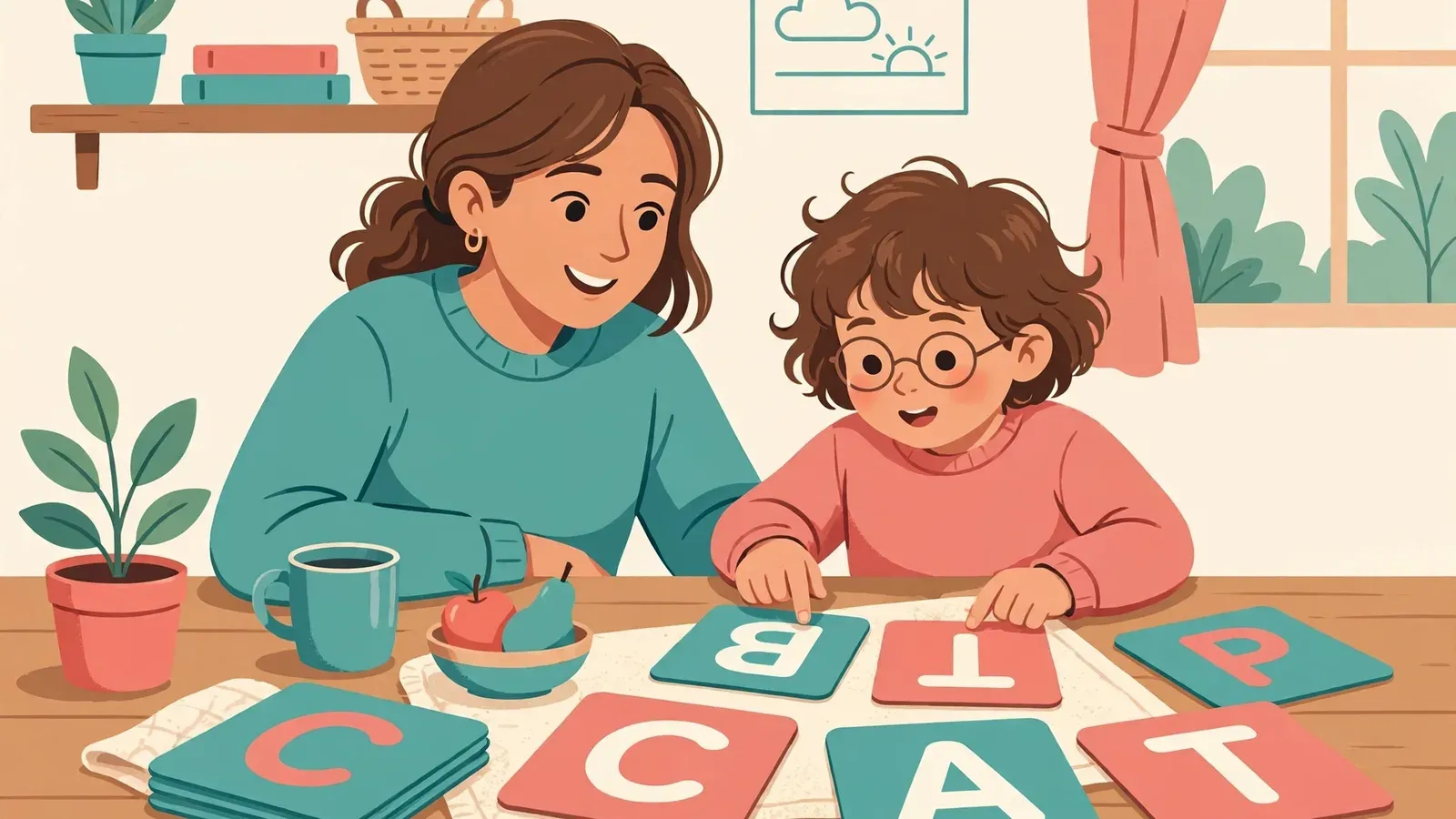
Phonics is the part of reading instruction most parents worry about — and the part that is actually the most straightforward to do at home. You don't need a curriculum to start; you need an order, a few minutes a day, and the habit of saying sounds cleanly. This guide covers the phonics teaching itself, step by step.
For the bigger picture — the full sequence from first sounds to independent reading, daily routines, and choosing a curriculum — see our complete guide to teaching your child to read at home. That page is the journey; this page is the phonics deep-dive.
What phonics is (in 60 seconds)
Phonics is the link between letters and sounds. A child who knows phonics can look at the letters c-a-t, say the three sounds, and blend them into the word cat — without memorizing the word or guessing from a picture. Two skills do almost all the work:
- Blending — pushing individual sounds together to read a word: /d/ /o/ /g/ → dog.
- Segmenting — splitting a word back into its sounds to spell it: pat → /p/ /a/ /t/.
Everything in this guide is in service of those two skills. Letter names, worksheets, and games are all just ways to practice them. (For how phonics fits into the full reading sequence, see Step 2 of our complete guide.)
When to start: 5 readiness signs
Age is a rough guide — most children are ready sometime between 4 and 6 — but these five signs tell you more than a birthday does:
- They enjoy being read to and ask for the same books again. Interest in stories comes before interest in letters.
- They can hear the first sound in a word. Ask "What sound does ball start with?" — if they can pick out /b/, their ear is ready.
- They like rhyming games. Finishing "The cat sat on the…" with a rhyme shows they can hear sound patterns.
- They're curious about letters. Pointing at signs, asking "What does that say?" or naming letters on cereal boxes.
- They can focus for a few minutes on something they chose — five minutes of attention is enough to start.
Missing one or two signs is normal; missing most of them means wait. The right move when a child isn't ready is not to push phonics — it's to keep reading aloud, playing rhyming games, and talking. Our preschool reading readiness guide walks through what to do in that waiting period, sign by sign.
The order to teach sounds
Don't teach sounds in alphabetical order. The order that works is the one that lets your child read real words as early as possible. Start with s, a, t, p, i, n — the first group in Jolly Phonics and the first two sets of the UK's Letters and Sounds Phase 2. After just those six sounds, your child can blend and read words like sat, pin, tap, tin, nap, and sip.
Why this order works:
- Each sound is distinct. The sounds don't look or sound alike, so children confuse them less than they would with, say, b/d/p all at once.
- They combine immediately. Six sounds make dozens of real words — your child gets the payoff of reading on day one, not week six.
- They're all "stretchable." You can hold /s/, /a/, /m/, /n/ out loud, which makes blending much easier than starting with stop sounds like /t/ or /p/ alone.
Teach one or two sounds at a time, and don't add a new one until the current ones are recognized on sight most of the time. A good pace is one new sound every few days — a child who knows six sounds solidly reads sooner than a child who has "met" all 26 but remembers none of them. After s, a, t, p, i, n, the usual next group is m, d, g, o, c, k — which opens words like dog, mop, cat, and kid. From there, follow your program's sequence or your kindergarten reading plan, which maps the order to the school year.
Pure sounds: say /m/, not "muh"
This is the single easiest mistake to fix, and the one most parents make. When you teach the sound for the letter m, say /m/ — a clean hum, mouth closed, no vowel after it. Don't say "muh." A child who learned "muh" will try to blend "muh-ah-tuh" into a word and get stuck; a child who learned /m/ blends /m/ /a/ /t/ into mat cleanly.
The rule: clip the sound short. Say each sound as briefly as you can, with no extra "uh" trailing off the end. A few to practice before you teach them:
- /s/ — a hiss, like air escaping a tire. Not "suh."
- /m/ — a hum with lips closed. Not "muh."
- /t/ — a tiny puff of air, tongue to the roof of the mouth. Not "tuh."
- /f/ — blow air through your teeth. Not "fuh."
- /n/ — hum with tongue behind your teeth. Not "nuh."
If you catch yourself adding the "uh," slow down and whisper the sound. Whispering makes the extra vowel almost impossible to add — which is exactly why it works as a teaching trick, too.
Blending and segmenting: the 2-minute mini-lesson
Blending is the moment reading clicks, and it's worth teaching deliberately rather than hoping it happens. Here's a 2-minute lesson you can run with magnetic letters or letter cards:
- Lay out d, o, g. Point to each letter and say its sound, slowly: /d/ … /o/ … /g/.
- Speed up gradually. Say the sounds again, a little closer together each time: /d/ /o/ /g/ → /do/ /g/ → dog.
- Let your child do it. Hand them the letters and ask them to "push the sounds together." If they stall, model it once more — don't correct, just show.
- Finish with a win. Ask them to read it once more, fast, then celebrate the word. One word, done well, beats ten words rushed.
Segmenting is the same skill in reverse, and it's how spelling starts. Say a word — pat — and ask your child to chop it into sounds, tapping one finger per sound: /p/ (tap) /a/ (tap) /t/ (tap). Three taps means three sounds. Start with three-letter words made only of sounds they've learned; the word fish can wait — it has four letters but only three sounds, which is a lesson for later. If blending stalls for weeks, try going back to oral blending first: no letters at all, just you saying /c/ /a/ /t/ out loud and asking what word that makes. The skill transfers once the ear gets it.
A sample 20-minute session
Same time, same place, five days a week. Here's a shape that works for most families — adjust the minutes to your child's attention, not the other way around:
- 5 minutes: review sounds. Flip through the letter cards you've taught so far. Your child says each sound. Anything missed goes back in the pile for tomorrow — no drilling, no tears.
- 10 minutes: blending games. Pick one game from the list below, or run the 2-minute mini-lesson with three new words. This is the teaching heart of the session.
- 5 minutes: read a decodable book together. Your child reads the words they can sound out; you read the rest. End on a page they read well. Our best books for beginning readers list and our decodable books guide help you pick books that only use sounds your child already knows.
End while it's going well — five minutes early is better than five minutes too late. A child who finishes happy comes back tomorrow; a child who finishes in tears doesn't.
5 no-prep phonics games
- I Spy, sounds version. "I spy with my little eye something that starts with /s/." Use sounds, not letter names — that's the whole point.
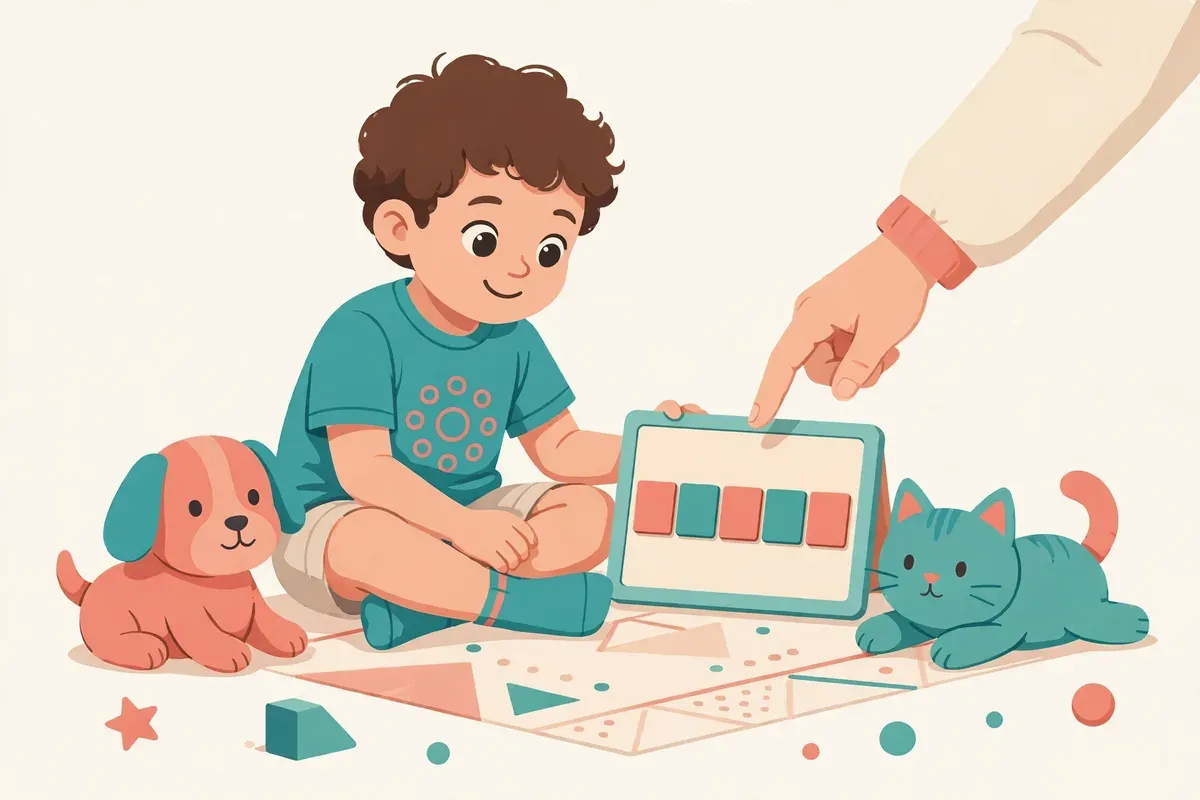
- Sound boxes. Draw three boxes on paper. Say a word like sun; your child puts one counter (a coin, a button) in a box for each sound. Three sounds, three boxes.
- Magnetic letters on the fridge. Put out the sounds you've taught, then call out a word — your child builds it. Swap one letter to make a new word (cat → bat) and watch their face when they realize they can read a "new" word already.
- Guess the first sound. Line up three toys. "Which one starts with /d/?" The dog, not the cat. Works in the car, in line at the store, anywhere.
- Change the first sound. Start with pin. "What if we change /p/ to /t/?" — tin. Now change it to /w/ — win. One word family, endless rounds, zero preparation.
When it's not working
Every child hits a wall somewhere in phonics. The fix is almost always to go slower and smaller, not to push harder:
- Slow down the sound order. If new sounds aren't sticking, stop adding them. Two weeks on six solid sounds beats six weeks of forgetting twelve.
- Go back to oral blending. If written letters are getting in the way, drop them for a few days. Blend sounds out loud only, with no letters in sight, until the ear catches up.
- Shorten the session. Ten focused minutes beats twenty resentful ones. You can always add a second short session later in the day.
- Change the game, not the goal. If letter cards bore your child, switch to the fridge magnets or a treasure hunt. The skill is the same; the wrapper changes.
- Check the book level. If your child melts down during reading time, the book is probably too hard. Drop back to books using only taught sounds — accuracy should be around 9 words in 10.
If you've slowed down, shortened sessions, and gone back to oral blending for several weeks with little progress, it may be time for a different kind of help. Our honest guide to reading curriculum for struggling readers covers when to seek an evaluation and which programs are built for that situation. And if the issue is your time or confidence rather than your child's progress, an app-led program can carry the teaching while you supervise — our Hooked on Phonics review covers one option honestly, including what it doesn't do well.
Frequently asked questions
Do I need to be a teacher to teach phonics at home?
No. Teaching phonics at home is mostly about following a clear order and keeping sessions short and regular. Scripted programs tell you exactly what to say, and app-led programs do the teaching while you supervise. What matters is consistency — 15–20 minutes a day, five days a week — not a teaching degree.
Should I teach letter names or letter sounds first?
Letter sounds first. A child who knows that the letter 's' makes the sound /s/ can start blending words like 'sat' after just a few sounds. Letter names come naturally later and don't help a child read — knowing the name 'ess' doesn't tell you what sound to make. Introduce the name only after the sound is solid.
How many minutes a day is enough?
Fifteen to twenty minutes of focused phonics time is enough for most 4- to 6-year-olds. Shorter is fine on hard days — two good 10-minute sessions beat one forced 30-minute one. Keep read-aloud time separate: that's extra, and it does different work (vocabulary and comprehension).
What if my child is older and never learned phonics?
Start at the same place — sounds, then blending — but move faster. An older child usually learns the first sounds in days rather than weeks because their language and attention are more developed. Don't skip the blending practice, though: that's the skill that turns known sounds into reading. If your child is frustrated or far behind peers, see our guide to reading curriculum for struggling readers.
How is this different from just reading aloud together?
Reading aloud builds vocabulary and comprehension — your child hears words years above their own reading level. Phonics builds decoding — turning letters into sounds and sounds into words. A child needs both. Read-alouds alone won't teach a child to read, and phonics alone won't teach them to understand what they read.
Sources: Sound order (s, a, t, p, i, n) is Jolly Phonics Group 1 and the first sets of Letters and Sounds Phase 2 (checked October 2026). Competitor pages reviewed for this guide: Brighterly, "How to Teach Phonics at Home" (updated October 20, 2026, read in full October 25, 2026); kateeducation.com, "How to Teach Phonics at Home: A Beginner's Guide"; GreatSchools, "10 Ways to Help Your Child With Phonics."