
How this guide was researched
Honesty first: this is general guidance, not a program we tested with our own children. It is built on verifiable sources, checked October 19, 2026 — education publishers and homeschool resources, not anecdotes. Where a source doesn't cover something, we'll flag it instead of guessing. Full details on how we research.
This guide was drafted with AI assistance and edited by our team. All facts come from the sources listed in Sources below.
What fact fluency means
Fact fluency means a child can recall basic math facts — simple calculations in addition, subtraction, multiplication, and division — accurately, quickly, and effortlessly. When facts are automatic, a child retrieves them from long-term memory without conscious effort, the way you read this sentence without sounding out each word.
Math educators Graham Fletcher and Tracy Johnston Zager, authors of Building Fact Fluency, add a crucial word to the usual definition: flexible. Their framing — "fact fluency means students know and can use their facts" — breaks fluency into three parts:
- Accurate — the child gets the right answer (8 + 9 = 17).
- Efficient — the child uses a strategy that saves time or effort, like counting on from the bigger number instead of counting everything from one.
- Flexible — the child knows multiple solution paths and picks the right one for the problem at hand.
This is the same "structured understanding first, memorization second" instinct behind our structured vs. balanced literacy discussion — in math, too, rote recall without understanding is a shaky foundation.
What fluent looks like in practice
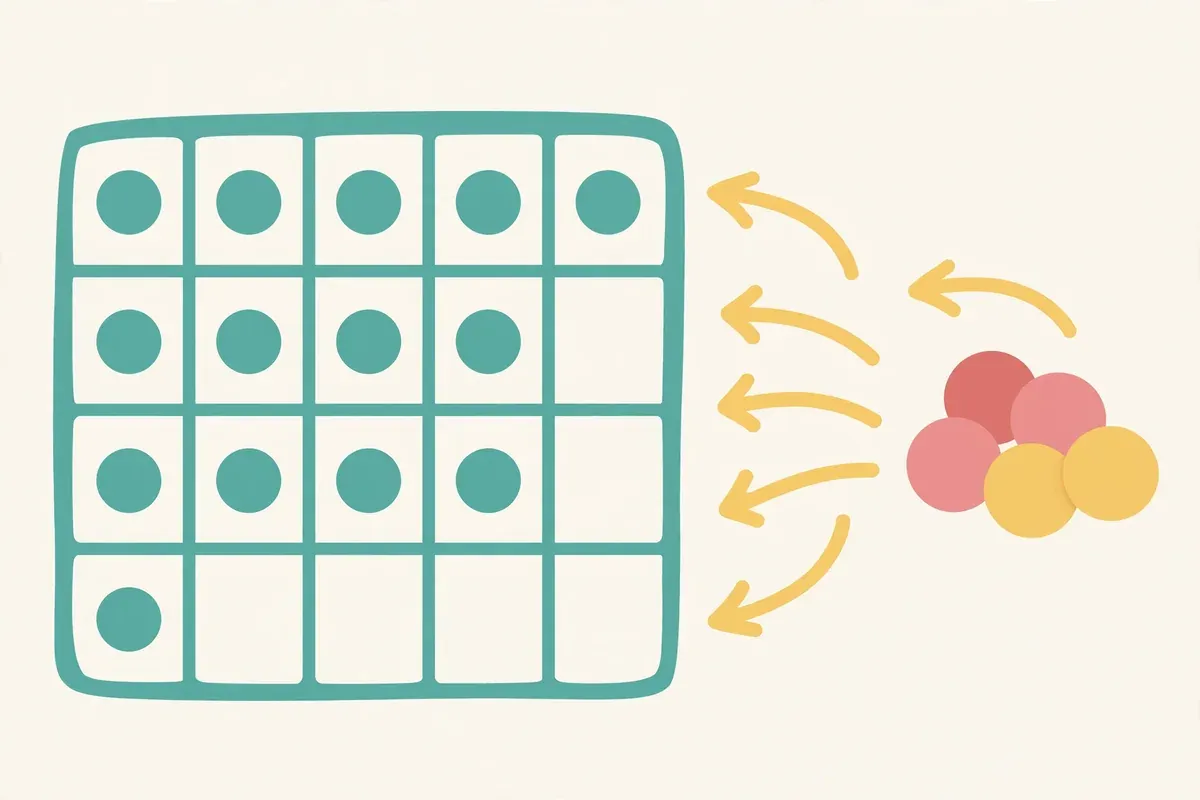
A fluent child solving 8 + 9 might think: "I like tens. Nine is close to 10, so I'll take 1 from the 8 and give it to the 9 — that's 7 + 10 = 17." Another child might use doubles: "I know 8 + 8 = 16, so 8 + 9 is one more." A third might simply remember it. All three are fluent — the hallmark is not which path they take, but that they arrive without laborious counting.
The contrast: a child who still counts every problem on their fingers for facts they "should" know isn't being lazy — they're telling you the fact isn't automatic yet, and more strategy work (not more pressure) is what's needed.
Why fact fluency matters
The case for fluency isn't about speed for speed's sake. It's about working memory:
- It frees the brain for harder math. Research going back to Geary (1994) shows that when basic facts are automatic, children can devote their working memory to problem-solving and learning new concepts instead of burning it on 7 + 8. Mathnasium's parent guide puts it plainly: without fluency, a child's progress with problem-solving, algebra, and higher-order concepts is significantly hindered.
- It changes how the brain computes. Brain imaging studies (Rivera, Reiss, Eckert & Menon, 2005) found that the shift from effortful finger-counting to automatic retrieval is associated with actual changes in the brain regions involved in mathematical computation.
- Retrieval speed predicts bigger outcomes. Extensive research finds that fact-retrieval speed predicts standardized test performance, word-problem success, data interpretation, and mathematical reasoning — and that multiplication fluency specifically affects success with fractions.
If your child stalls on multi-step problems despite understanding the concepts, weak fact fluency is worth ruling out — the same diagnostic instinct we recommend when reading practice stalls.
What to expect by grade
U.S. grade-level expectations for fact fluency (per the Common Core State Standards for Mathematics):
| Kindergarten | Fluently add and subtract within 5 |
|---|---|
| Grade 1 | Add and subtract within 20; fluent within 10 |
| Grade 2 | Fluently add and subtract within 20; know from memory all sums of two one-digit numbers |
| Grade 3 | Fluently multiply and divide within 100; know from memory all products of two one-digit numbers |
Treat these as mile markers, not deadlines. A child who reaches them a semester later with solid understanding is in better shape than one who was drilled to them early with no number sense underneath.
The catch: three mistakes to avoid
- Treating timed tests as the only measure. Timed tests show speed and accuracy, but they can't show whether a child is decomposing numbers, using make-a-ten, or applying the distributive property. Math educators note that relying on them alone can miss the flexible thinking that real fluency requires — and the pressure can backfire for anxious kids. Use them sparingly, as one data point among several.
- Flashcards before understanding. The old sequence — memorize first, understand later — is backwards. Research says fluency should be an outcome of problem solving, not a prerequisite for it. Flashcards have a place, but only after the child understands what the facts mean: use them for committing already-understood facts to memory, not as the teaching method itself.
- Mistaking speed for fluency. A child who answers 6 × 7 = 42 instantly but can't explain any way to get there (and falls apart on 6 × 8) has memorized an answer, not built fluency. The flexible piece — multiple strategies, choosing well — is what makes facts usable in harder math.
How to build fact fluency at home
Adapted from Mathnasium's parent guidance and homeschool-tested activities, in the order that works:
- Start with understanding. Before facts can be memorized, children need to see how numbers work. Use household items — buttons, coins, snacks — plus number lines, base-ten blocks, or printable ten frames to show what adding and subtracting actually look like. This builds number sense that recall will later rest on. (The same manipulatives-first instinct applies to early reading readiness.)
- Teach a few flexible strategies. Make-ten (8 + 9 → 8 + 2 + 7), doubles and near-doubles (6 + 6 = 12, so 6 + 7 = 13), skip counting for multiplication, and fact families (3 × 4 = 12, so 12 ÷ 4 = 3). A small toolbox of strategies beats a hundred memorized answers.
- Keep practice short, frequent, and playful. Five to ten minutes a day outperforms a weekly hour. Try flashcard races, tossing a ball while solving facts, sidewalk-chalk answers, or "math basketball" (each correct answer earns a shot). This is the same daily-routine muscle our kindergarten and first-grade reading plans are built around — small, repeatable, low-friction.
- Use games, not just worksheets. Homeschool families report good results with card games (flip two cards, add/subtract/multiply — highest answer keeps the cards), the "fact of the day" posted on the fridge for casual quizzing, and number-line race games with toy cars.
- Watch how they solve, then adjust. If a child is stuck, the fix is rarely "more of the same." Drop back to the strategy level: can they show it with blocks? Can they use a fact they know to reach one they don't? Observe first, drill second.
A simple 5-day practice routine
About 5–10 minutes a day, no special materials beyond cards, dice, and household objects:
| Monday | Warm up with manipulatives — build make-ten facts on a ten frame (8 min) |
|---|---|
| Tuesday | Strategy focus — doubles and near-doubles, then a round of card war (10 min) |
| Wednesday | Fact of the day on the fridge; casual oral quiz through the day (5 min) |
| Thursday | Fact-family triangles — link multiplication and division facts (8 min) |
| Friday | Game day — number-line car races or flashcard relay; celebrate the week's wins (10 min) |
Signs it's working
- Finger-counting fades on facts the child has practiced — not because you banned it, but because they don't need it.
- They explain their thinking unprompted: "I knew 8 + 8, so 8 + 9 is one more."
- They switch strategies between problems instead of using one rigid method.
- Answers come without long pauses or visible strain — the effort moves up to the actual problem, not the arithmetic inside it.
Frequently asked questions
What is fact fluency in math?
Fact fluency is the ability to recall basic addition, subtraction, multiplication, and division facts accurately, quickly, and effortlessly — and to use them flexibly. A fluent child not only knows that 6 × 7 = 42, but can also apply related strategies, like breaking 8 + 9 into 8 + 2 + 7.
How much should my child practice math facts each day?
About 5 to 10 minutes of focused, strategy-based practice beats a long worksheet session. Mathnasium's guidance for parents puts the sweet spot at short, frequent, playful sessions — consistency matters more than duration.
Are timed tests good for building fact fluency?
Timed tests are one data point, not the whole picture. Math educators warn that speed-only testing can't show whether a child is using flexible strategies — and for some children, the pressure backfires. Watch how your child solves a fact, not just how fast.
When should my child know multiplication facts?
U.S. grade expectations call for fluent multiplication and division within 100 by the end of grade 3, with all products of two one-digit numbers known from memory. Introduce them after addition and subtraction fluency, starting with skip counting and arrays before memorization.
The bottom line
Fact fluency is accurate, efficient, and flexible recall of basic math facts — built through understanding first, a few good strategies, and 5–10 playful minutes a day. Skip the pressure, watch how your child solves, and let speed be the byproduct of understanding rather than the goal.
Sources
- K5 Learning — Why do Kids Need to Learn Math Facts? (checked October 19, 2026)
- Zaner-Bloser — 3 Ways to Assess Math Fact Fluency (checked October 19, 2026)
- Mathnasium — 5 Easy Steps to Help Your Child Build Math Fact Fluency (checked October 19, 2026)
- Homeschool Compass — Math Memorization Fun (checked October 19, 2026)
- SMathSmarts — Assessing Mathematical Fluency (checked October 19, 2026)